Corporate campuses in Riverdale sit at the intersection of visibility and performance. Clients and employees form impressions before they ever step through a lobby door, and facilities managers live with the day-to-day realities of budgets, water restrictions, and plant health under Georgia’s heat. Smart irrigation has moved from a nice-to-have to the backbone of corporate landscape maintenance. When it’s dialed in correctly, it protects plantings, cuts water spend, and stabilizes service schedules so office grounds maintenance teams can focus on the details that elevate a property.
This is a practical look at what works across corporate office landscaping, business park landscaping, and office complex landscaping in and around Riverdale. The focus is the layer where technology meets horticulture: controllers, soil, spray patterns, and maintenance programs that stay on track in August when storms roll through, and in April when the first real growth surge hits.
Why Riverdale’s microclimate drives the plan
Most vendors talk about “the Atlanta climate” as if it were one homogenous set of conditions. Riverdale tells a more specific story. Rainfall averages around 45 to 50 inches a year, but summer storms can drop an inch in an hour, then leave two weeks of heat in the mid 90s with humidity high enough to stress turf and shrubs. Clay-heavy soils dominate. They drain slowly and compact easily, which means runoff becomes your enemy if spray heads and cycles aren’t tuned. Shade patterns vary across corporate property landscaping, especially on campuses bracketed by tree lines or adjacent buildings. A south-facing office park courtyard with reflective glass can behave like a heat sink, while an east exposure under pines can stay damp long after a rain.
Irrigation schedules that ignore these nuances burn money and stress plants. Schedules that respond to them unlock the two wins every manager wants: resilience and efficiency.
The baseline: inventory the landscape and the infrastructure
Before bringing in smart controllers or scheduling corporate landscape maintenance contracts, map what you have. On mixed-use corporate office landscaping, we aim for a clean inventory within the first two weeks of engagement, even for short-term office park maintenance services. The pass should cover plants, irrigation hardware, pressure, and water sources.
- Planting zones: Group lawn areas by sun exposure and foot traffic. Spot the “hot zones” near pavement and dark stone that reflect heat. Flag ornamental beds with water-sensitive species like loropetalum or azaleas, which hate wet feet. Note wind corridors between buildings where spray drift becomes a problem. Irrigation hardware: Identify controller makes and models, valve counts, head types, nozzle sizes, and any subsurface drip. Look for mismatched nozzles in the same zone, a common legacy issue. Record static and dynamic pressure at key points so you know whether pressure regulation is needed. Water sources and metering: Confirm whether the property is on city water, reclaimed water, or a dedicated well. Confirm backflow locations and meter read access. In Riverdale, expect tiered water rates. If a campus has more than one meter, consider separate tracking for lawn zones vs. ornamental beds to avoid waste hiding in the average. Soil conditions: Pull a few cores across lawn and bed zones. Document compaction depth, infiltration rate, and organic content. On corporate grounds maintenance programs, this step informs whether mulching, aeration, or soil amendments should proceed before or alongside irrigation upgrades.
This inventory supports a realistic plan for office landscape maintenance programs and sets expectations. If an office complex landscaping site has mixed rotors and sprays on the same zone, water efficiency gains will be limited until zoning is corrected. Better to state that up front.
What “smart irrigation” actually means on a corporate campus
The term gets stretched. In practice, smart irrigation for corporate property landscaping combines four pieces that work together: weather-aware controllers, soil moisture sensing, hydrozoning, and mechanical fine-tuning.
Weather-aware controllers: Modern controllers read local weather forecasts, not just past rainfall. In Riverdale, the forecast is as important as the history because pop-up storms can be intense, then followed by dry heat. A good controller delays or reduces cycles ahead of known rainfall and scales runtime when cloud cover keeps evapotranspiration lower. The simplest immediate win is rain shutoff with an accurate local rain tipping bucket sensor, but the step change comes with ET-based adjustments that align with seasonal demand.
Soil moisture sensors: Where budgets allow, soil sensors in representative zones close the loop. On corporate campuses with multiple building exposures, placing probes in a west-facing bed, a central turf island, and a shaded courtyard can capture the spectrum. The controller uses thresholds to halt irrigation once the root zone is adequately charged. It’s easy to overshoot in clay soils, so sensors earn their keep quickly.
Hydrozoning: Plants with similar water needs should share a zone. Many older systems blend turf and shrubs on one valve because it was fast to install that way. The outcome is predictable: either you drown the shrubs trying to keep the lawn happy, or you starve the lawn to keep beds from going mushy. On business campus lawn care, we push to separate turf rotors from bed drip or matched-precipitation sprays during refresh cycles. Even if full re-piping isn’t feasible, capping a few heads and reallocating a bed to drip laterals can cut water usage by 25 to 40 percent in those areas.
Mechanical fine-tuning: Smart controllers can’t correct a 270-degree nozzle installed where a 90-degree arc belongs. They also can’t fix head spacing errors. For corporate lawn maintenance, we standardize to matched precipitation nozzles, align head-to-head coverage, and install pressure-regulating stems or heads to maintain target operating pressure. On commercial office landscaping with frequent pedestrian traffic, we use check valves on heads in sloped turf to prevent low-point drainage that causes muddy curb lines.
Bed vs. turf: different rules, different mistakes
Office grounds maintenance often unravels because beds and turf get treated like variations of the same system. Turf demands regular cycles during peak heat, with occasional deep watering to push roots down. Ornamentals want less frequent but more measured irrigation. In Riverdale’s clay, roots need air as much as they need water. Long wet periods produce fungal issues in liriope and boxwood that ripple into plant loss and redo costs.
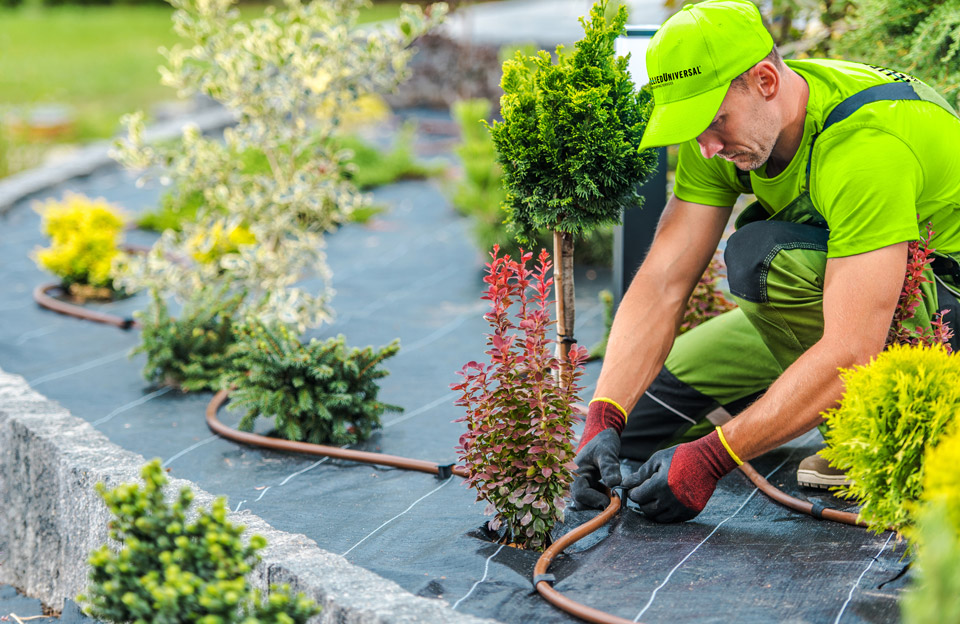
For bed zones in corporate office landscaping, drip irrigation with inline emitters at 12 or 18 inch spacing delivers steady moisture without foliage wetting. A simple mulch layer, 2 to 3 inches, cuts evaporation and breaks clay surface crusting. Drip also avoids the overspray conflict that happens when walkways slice through beds. It’s harder to vandalize, too, which matters on open corporate campuses that double as public pathways.
For turf, rotors should run in cycles that allow infiltration. If the clay can accept a quarter inch per cycle, break a one inch weekly target into four or five passes. With weather-aware control, that distribution shifts week by week. Mow height matters more than most finance teams realize. At 3 to 3.5 inches for common warm-season grasses, turf shades its own roots, requiring less water. Drop the deck to a cosmetic 2 inches to impress a regional director before a site visit, and you can add 15 to 20 percent to water demand for two weeks while the turf recovers.
Scheduling the work: rhythm for office park maintenance services
Reliability builds trust on corporate maintenance contracts. The calendar should be as visible as a safety plan. The sites that stay lush in August usually earned it with disciplined spring steps.
Preseason (late February to early March): Audit controllers, flush lines, replace clogged filters, and test every zone. Correct coverage issues now while plant canopy is forgiving. Apply pre-emergent to turf, top off mulch, and schedule aeration if compaction is heavy. Review controller firmware updates and verify active weather services.
Spring ramp (late March to May): Gradually increase turf runtimes as growth accelerates. Keep bed irrigation conservative. Spot-check soil moisture with a probe weekly in the first month to align expectations. On office landscape maintenance programs, we train on-site staff to log anomalies: drifted heads, low pressure in a zone, or consistent puddling after certain cycles.
Summer load (June to August): Enter the long game. Heat and thunderstorms challenge consistency. The smart controller should throttle irrigation ahead of forecast rain and shift to shorter, more frequent cycles when humidity and night temperatures rise. Fertility and mowing height balance water demand as much as runtime does. A campus that mows too low or applies heavy quick-release nitrogen will chase water endlessly.
Fall reset (September to November): Begin tapering turf irrigation as night temperatures drop. Use the breathing room to execute selective plant replacements in beds where summer exposed poor species choices. In many corporate properties, this is the season to rewire a few problem zones and move a stubborn valve box that always floods.
Winter maintenance (December to January): In Riverdale, full blowouts are not always required, but freeze protection is. Install insulation on backflows and program controllers to deep sleep with periodic system checks. Winter is the right time to expand drip in ornamental beds and swap out mismatched nozzles without chasing growing turf.
Dollars and proof: what the numbers look like
Facilities leadership asks fair questions: How much water will this save, and how quickly will it pay back? The answer depends on starting conditions. On a 10 to 15 acre office park with a mix of turf and ornamental beds, upgrading to weather-based control and cleaning up nozzles typically reduces irrigation water use by 20 to 35 percent. Adding soil sensors in representative zones often adds another 8 to 12 percent. Converting key ornamental beds from sprays to drip usually removes 30 to 50 percent of water from those beds with better plant health, particularly for drought-tolerant selections.
In Riverdale, water rates vary, but a conservative blended rate for commercial irrigation can put annual water cost on a 12-acre irrigated area in the mid five figures. A 25 percent reduction on a 60,000 dollar annual irrigation bill is 15,000 dollars. Controller upgrades with sensors for a campus of that size often land between 12,000 and 25,000 dollars, depending on how many controllers and whether communications modules are needed for central management. That means simple paybacks in the 9 to 20 month range, faster if a municipality applies irrigation surcharges in summer tiers.
There’s also the hard-to-quantify avoidance. When shrubs decline from chronic overwatering and replace orders hit in July, the labor premium and plant stress often double soft costs. On commercial office landscaping, we track plant loss rates as a key KPI. Sites that move to drip and sensor-backed control commonly cut bed plant replacements by half year over year. That shows up as stability in the budget and fewer panicked calls before executive visits.
Plant selection that plays well with smart irrigation
Hardware does its best work when plant palettes cooperate. Corporate grounds maintenance benefits from assemblies that tolerate slight swings in soil moisture. In full sun, warm-season turf species adapted to the Piedmont do well, but edge conditions matter. On south and west exposures high in reflected heat, turf will ask for more water than many office managers want to pay for. Converting those strips to ornamental grasses and groundcovers pays dividends.
For beds, Riverdale-friendly combinations often include hollies, viburnum, encore azalea in moderated exposures, dwarf yaupon, abelia, and sun-tolerant perennials like salvia and lantana. In parking islands, tough performers like little bluestem, rosemary, and dwarf crape myrtle handle reflected heat and intermittent dry cycles. Smart irrigation thrives when zones aren’t forced to babysit fussy plants next to heat-tolerant ones. If the palette insists on diversity, focus on grouping by water need and sun exposure rather than by bloom color alone.
Central control and accountability across campuses
Managed campus landscaping spreads risk across multiple buildings and sometimes multiple meters. A central dashboard where a facilities manager or a service provider can see all controllers in one place turns smart irrigation from a gadget into a program. Water windows can be standardized to avoid interference with evening events. Alerting on flow anomalies catches stuck valves and mainline breaks before they become weekend emergencies.
Recurring office landscaping services should include monthly controller audits. At a minimum, review actual runtimes, rainfall offsets, and any manual overrides. Controller passwords should be managed like access badges. Too many corporate properties let anyone with a ladder open a cabinet and bump runtimes when a hot week hits. That works for seven days and costs you for ninety.
The people side: training and small habits that move the needle
Technology doesn’t replace a skilled field crew. If your provider rotates staff through sites, make sure the team assigned to your corporate campus landscaping understands how your controllers behave. A five-minute check-in at the start of the service visit to verify last week’s rain pause and spot-test soil moisture with a handheld probe prevents overreactions.
Trash can lids, skateboards, and parked cars are the enemies of plan-to-execution in office complex landscaping. The best crews walk the perimeter before watering windows begin. They nudge around portable obstacles or shift a zone start to avoid a predictable overspray onto vehicles. The habit is free. The savings arrives in avoided complaints and safer, drier entrances.
Compliance, water restrictions, and communication
Clayton County and nearby jurisdictions may impose watering restrictions during drought periods. Smart irrigation is a compliance ally as much as an efficiency tool. Set controllers to permitted days and hours, then let ET adjustments work within that window. If restrictions tighten, communicate changes to property managers and tenants with simple signage. Most people accept a browner turf if they know the site is following rules and protecting long-term plant health. The worst optics come from watering in the middle of a no-watering window because a manual override stuck. Central control and alerts prevent that embarrassment.
Maintenance contracts that match corporate reality
Corporate maintenance contracts should specify responsibilities on both sides. On our most stable corporate maintenance contracts, we define who owns the water bill monitoring, who approves runtime strategy changes at seasonal shifts, and when audits occur. For recurring office landscaping services, we attach a short seasonal plan: spring targets for turf height, summer irrigation priorities for high-visibility entrances, fall renovation windows, and winter freeze protocols for backflows.
Tie performance to measurable outcomes. Water usage per acre, plant replacement counts by zone, and irrigation repair response times matter more than vague language about “well-maintained appearance.” For business park landscaping with multiple tenants, a shared dashboard or monthly one-page summary keeps property managers, facility teams, and accounting aligned. Transparency reduces vendor churn, which usually causes more waste than any single line-item inefficiency.
Typical pitfalls and how to avoid them
Underestimating clay soil behavior: If you never adjust cycle-and-soak programming, water will sheet off slopes and starve roots even as the water bill grows. Use shorter cycles with soak windows and track infiltration in different zones.
Mismatched nozzles on one zone: One head throws twice as far as its neighbor, so the nearby bed stays soggy and the far edge turns brown. Standardize to matched precipitation. It’s often a half-day project that pays off for years.
Ignoring pressure: High pressure shreds droplets into mist, which drifts into parking lots. Low pressure causes short throws and dry arcs. Pressure-regulating heads or in-line regulators stabilize your system. Confirm static and dynamic pressure before choosing a fix.
Seasonal whiplash settings: Setting runtimes in May and forgetting them until September is a water-loss plan. ET-based control helps, but a monthly quick review cements the savings.
Leaving tenants in the dark: If your corporate property landscaping includes tenant spaces, they will unknowingly move planters under sprays, prop doors open into bed zones, or adjust heads to avoid a splash and create coverage gaps. Share a simple watering map and contact path for adjustments.
A brief case snapshot
office landscaping professionalsA Riverdale office park with four buildings and 11 irrigated acres entered a corporate landscape maintenance agreement that prioritized irrigation retrofit over cosmetic plant swaps. The site had three standalone controllers with outdated rain sensors and mixed-zone violations across turf and beds. Water spend for the prior 12 months hovered near 58,000 dollars.
We installed a central controller platform across the three panels, added two soil sensors in turf and one in ornamental beds, re-nozzled turf heads to matched precipitation, and converted 18,000 square feet of bed sprays to drip. The work occurred over six weeks without interrupting business hours. Summer arrived with two heat spikes and several storm cells. Over the next year, water usage dropped by roughly 31 percent. Two bed areas with chronic root rot stabilized, and plant replacements declined by just under half. The site’s worst curb puddling near a sloped entrance disappeared once check valves and cycle-and-soak programming were set. The property manager’s favorite win wasn’t the water bill. It was fewer complaints about wet sidewalks at 8 a.m.
How procurement can evaluate proposals wisely
Price comparisons fall apart when scopes differ. When you review office landscaping services proposals that promise smart irrigation benefits, require three specifics:
- Controller approach: Make, model, weather source, communication method, and whether central control is included with user access levels for your team. Zone corrections: A count of zones to be split or reconfigured, and a list of areas moving to drip, with square footage. Baseline and targets: Last 12 months of water usage on irrigation meters or submeter estimates, plus projected percentage reduction and the assumptions that drive it.
When vendors speak to these elements with clarity, the partnership tends to deliver predictable results. When they don’t, cost savings and plant health often become talking points rather than outcomes.
Where smart irrigation intersects with corporate brand
Landscape isn’t decoration, it’s part of the brand experience. A campus that looks good after a week of thunderstorms and then a week of heat telegraphs competence. Smart irrigation helps corporate property landscaping weather swings without panic adjustments. It gives facilities managers the confidence to set longer maintenance horizons, shift budget from crisis plant replacements to planned enhancements, and present sustainability metrics that hold up under scrutiny.
If you manage campus landscape maintenance in Riverdale, your best returns will come from choosing a provider that treats irrigation as a living system, not a clock. Pair that mindset with a plant palette tuned to the site, a schedule that respects the seasons, and clear accountability. Your corporate grounds will look sharper, your water spend will slide down instead of creeping up, and you’ll have fewer early morning surprises at the front door.